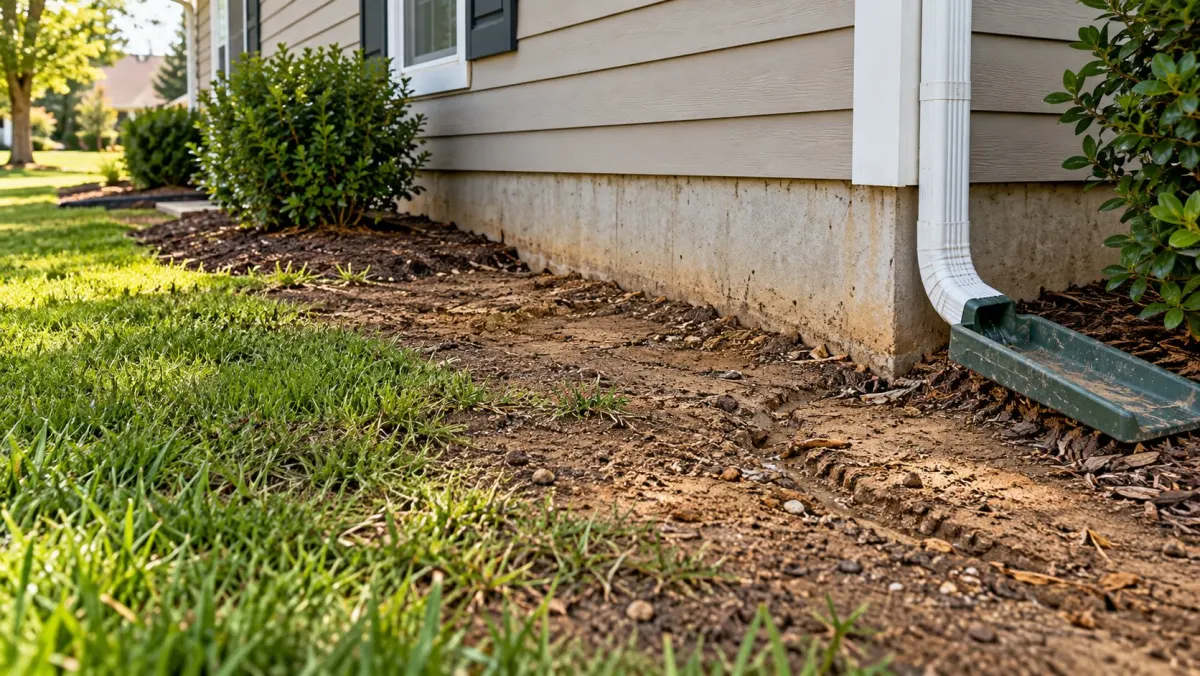
You walk around the outside of your home and notice an area where the grass has disappeared. Maybe the soil is exposed next to the foundation. Maybe rainwater has carved a small channel through the yard.
It may not look like much.
And bare dirt by itself doesn't necessarily mean something is wrong with your home.
But it can give you an important reason to pay attention to how water is moving around your property.
Water that repeatedly collects near the foundation, soil that is washing away, or grading that directs water toward the house can contribute to moisture problems and erosion over time.
The goal isn't to diagnose a foundation problem from the yard.
It's to recognize conditions worth investigating before they become bigger problems.
1. Bare Soil Can Tell You Something About Water Movement
Bare soil can develop for plenty of ordinary reasons—shade, foot traffic, pets, poor growing conditions, landscaping changes, or simply difficulty keeping grass alive.
But sometimes exposed soil also appears where water repeatedly flows across the property.
After a heavy rain, take a walk around your house once conditions are safe.
Look for:
- Water collecting near the foundation
- Small channels carved into the soil
- Washed-out mulch or landscaping
- Soil pulling away or eroding
- Downspouts dumping large amounts of water near the house
- Areas that remain unusually wet
You're not trying to diagnose anything.
You're trying to understand where the water goes.
What to do: Take photos of questionable areas after a heavy rain. Comparing pictures over time can help you determine whether the condition is stable or changing.
2. Pay Attention to the Grade Around Your Home
Ideally, surface water should move away from the house, not toward it.
Walk around the perimeter and look at the general slope of the ground.
Does the yard appear to slope away from the foundation?
Or does water naturally move toward the house and collect there?
Low spots can sometimes develop over time as soil settles or landscaping changes.
Even something as simple as adding a flower bed, edging, or large amounts of mulch can change how water moves around a property.
What to do: During or shortly after rainfall, observe the direction water travels. If significant water consistently moves toward the foundation or pools against the house, consider having the drainage evaluated.
3. Check Where Your Gutters and Downspouts Send Water
Your roof collects a surprising amount of water during a storm.
Your gutter system's job is to collect that water and move it somewhere appropriate.
That's why the end of the downspout matters.
If a downspout releases water directly beside the foundation, that same area may receive concentrated runoff every time it rains.
Look for:
- Disconnected downspout extensions
- Damaged splash blocks
- Water dumping directly beside the foundation
- Erosion underneath downspouts
- Overflowing gutters
- Downspouts that discharge into already-low areas
What to do: Make sure gutters and downspouts are functioning properly and directing water appropriately away from the home. If you're unsure where runoff should be directed on your property, consult a qualified drainage or landscaping professional.
4. Don't Assume More Mulch or Soil Automatically Fixes the Problem
Seeing bare dirt often creates an understandable reaction:
Cover it up.
But adding material without understanding why the area became bare may hide the symptom without addressing the cause.
You also want to be careful about piling soil or mulch too high against the house.
Exterior materials, drainage paths, foundation design, and local conditions all matter.
The better question isn't simply:
“How do I cover this dirt?”
It's:
“Why is this area bare, and what happens here when it rains?”
What to do: Before adding significant amounts of soil, mulch, rock, or landscaping near the house, understand how the change could affect drainage and the exterior of your home.
5. Make the Rainstorm Part of Your Home Inspection Routine
Some homeowner problems are difficult to understand on a sunny afternoon.
Drainage is one of them.
A heavy rain can reveal things you may never notice when the yard is dry.
When it's safe, periodically look around your property after significant rainfall.
Pay attention to:
- Standing water
- Water flowing toward the house
- New erosion
- Overflowing gutters
- Downspout discharge
- Wet areas that don't drain normally
- Changes from previous storms
You don't have to know exactly what caused something to recognize that something changed.
That's where documentation becomes valuable.
Take a picture.
Make a note.
Compare it after the next storm.
If the condition continues or worsens, you now have useful information to show a professional.
The Bigger Lesson
Homeownership isn't about becoming an expert in foundations, drainage, landscaping, plumbing, electrical systems, HVAC, and everything else under your roof.
It's about learning to notice changes early.
Bare soil isn't automatically a foundation problem.
Standing water isn't automatically structural damage.
A crack isn't automatically a catastrophe.
But patterns deserve attention.
That's why the BYBTH approach remains:
Anticipate. Ask. Document. Verify.
Notice what's happening.
Ask why.
Document what you see.
And when the situation warrants it, have the right professional verify what's actually going on.
If you notice bare soil or erosion around your home:
- Look at the area after heavy rain
- Observe which direction water flows
- Check for standing water near the foundation
- Inspect gutters and downspouts
- Look for erosion or washed-out landscaping
- Photograph questionable areas
- Compare conditions after future storms
- Avoid assuming that simply adding soil or mulch solves the cause
- Get professional drainage, landscaping, or foundation guidance when conditions persist or appear significant
When to Call a Professional
Consider professional evaluation when you see persistent water collecting near the home, significant or recurring erosion, drainage that consistently directs water toward the foundation, substantial changes in soil conditions, or other concerning changes around the property.
A qualified professional can evaluate the actual conditions at your home rather than trying to diagnose the situation from one visible symptom.
The goal isn't to panic when you see bare dirt.
The goal is to understand why it's there.